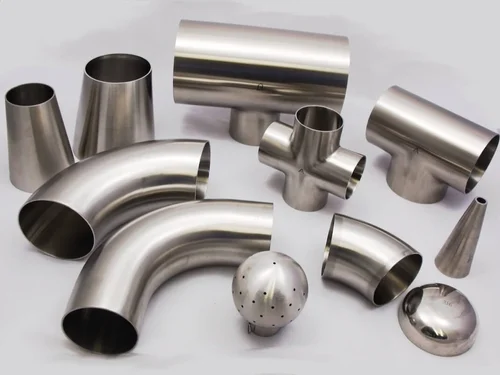
Stainless steel fittings are essential components used to connect stainless steel pipes and tubes, and they play a vital role in creating integrated systems for transporting liquids, gases, and various materials. These fittings are characterized by their durability and high resistance to corrosion and rust, making them suitable for numerous industrial and commercial applications.
Stainless steel pipe fittings are available in various shapes, sizes, and grades, and selecting the appropriate type depends on the nature of the project, the pipe diameter, and the temperature, pressure, and operating conditions.
What Are Stainless Steel Fittings?
Stainless steel fittings are components installed with pipes and tubes to connect parts of a piping system, change the direction of flow, split the pipe run, or connect pipes to equipment and valves.
These fittings are manufactured from various grades of stainless steel; grades 304 and 316 are among the most commonly used in many applications due to their good corrosion resistance and suitability for a wide range of operating conditions.
Why Are Stainless Steel Pipe Fittings Important?
The importance of fittings is not limited to simply connecting pipes; they also help in the design and proper implementation of piping systems.
Among their most important functions are:
Connecting pipes and tubes to one another.
Changing the direction of the pipe run.
Branching the pipeline into multiple runs.
Connecting pipes to equipment and valves.
Facilitating maintenance and the replacement of certain system components.
Helping to create piping systems suitable for various applications.
Types of Stainless Steel Fittings
Stainless steel fittings are available in various forms, and each type is used according to the design and requirements of the system.
- Stainless Steel Elbows
Stainless steel elbows are used to change the direction of the pipe run and are available in various angles, the most common being 45-degree and 90-degree elbows.
They are used in many piping systems, especially when the design requires a change in the direction of the pipe run while maintaining system efficiency.
- Stainless Steel Tees
Stainless steel tees are used to split the pipe run into two directions and typically come in a T-shape.
They are available in various types and sizes to fit the pipe diameters used in the system and are widely used in industrial applications and fluid transfer systems.
- Stainless Steel Flanges
Stainless steel flanges are used to connect pipes to equipment or to join different sections of a piping system; they also facilitate disassembly, installation, and maintenance.
Flanges are available in various designs and specifications to suit pressure requirements, pipe diameters, and the nature of the application.
- Couplings and Adapters
Certain types of couplings are used to connect pipes of different diameters or to transition from one type of connection to another.
These couplings help enable more flexible piping system designs, especially in projects that require connecting different components.
What is the difference between 304 and 316 stainless steel couplings?
Grade 304 and Grade 316 are among the most common grades of stainless steel used in the manufacture of fittings.
Stainless steel 304 offers good corrosion resistance and is used in many industrial and commercial applications.
Stainless steel 316, on the other hand, offers higher corrosion resistance in certain environments and may therefore be suitable for applications exposed to harsher conditions, chemicals, or saline environments, depending on the specific requirements.
Therefore, the choice between 304 and 316 stainless steel fittings should not be based solely on price; rather, the nature of the application and the environment in which the fittings will operate must be taken into account.
Key Applications of Stainless Steel Fittings
They are used in many sectors, including:
The food industry.
Water treatment plants and projects.
Chemical industries.
Pharmaceutical industries.
Fluid processing and transfer systems.
Factories and industrial facilities.
Commercial projects.
Various piping systems.
Their widespread use is due to their combination of durability, corrosion resistance, and the variety of shapes and sizes available.
How to Choose the Right Stainless Steel Fittings?
When selecting stainless steel fittings for a specific project, there are several factors to consider, the most important of which are:
Stainless steel grade:
Select the grade appropriate for the nature of the environment and application, such as 304 or 316.
Pipe size:
The dimensions of the fitting must match the diameter of the pipes being used.
Pressure and Temperature:
It is important to ensure that the fitting is suitable for the operating pressure and temperature.
Type of Fitting:
Elbows, tees, flanges, or valves are selected based on the fitting’s function within the system.
Nature of the Material Being Transported:
The type of liquids, gases, or materials passing through the system must be taken into account.
Why Is Stainless Steel Used in the Manufacture of Fittings?
The use of stainless steel in the manufacture of fittings stems from a set of properties that make it suitable for many applications, including:
Good resistance to corrosion and rust.
Durability and ability to withstand various operating conditions.
Long service life when used under appropriate conditions.
Ease of cleaning and maintenance.
Suitability for many industrial applications.
Availability in multiple grades and specifications.
In conclusion,
stainless steel fittings are an essential part of piping systems, as they help connect components, change the direction of flow, divide pipe runs, and connect them to various pieces of equipment.
The most common types of stainless steel fittings include elbows, tees, flanges, valves, and other fittings, with specifications, sizes, and stainless steel grades varying depending on the nature of the application.
When selecting stainless steel fittings, it is important to consider the material grade, size, pressure, temperature, and nature of the application to ensure the right product is chosen for the project.